Tuesday, November 17, 2009

Culture Day and Technical Training

So it’s been a busy couple of weeks since I was able to post last (You have no idea how difficult using the internet can be here!). We had our “culture day” performances on the 7th, and that was a lot of fun. Our dance actually went pretty well and I was relieved that I didn’t screw it up. The dance we taught to the kids was a big hit and the crowd seemed to really love it. Our host familes dressed us all up in Tongan outfits and also made our dance costumes. Mine consisted of a mat which was wrapped around me and then tied. I also wore pieces of fabric with shells glued to them on my wrists and ankles and an elaborate flower thing around my waist. Pele had a similar outfit, though her dress was fabric and decorated with these things made from cassette tape. The guys in our village group wore these things made from leaves- basically just a leaf skirt and that was all. Their dance was also a big hit- a neighbor actually mentioned that people are still talking about it even though it happened about 2 weeks ago! I will try to get some pictures of all that up soon.

Last week we did our technical training, which consisted of teaching strategies, classroom management, lesson planning, etc. It was pretty helpful, (some parts more than others), though it was pretty tedious sitting in the hall from 8:30 to 4:30, especially since the benches are really hard and uncomfortable. By the end of the week, I made sure to run in and snag one of the few plastic chairs so my back wouldn’t be aching by the end of the day. 

This week we’ll be doing our practice teaching. We had our first day today and I felt like it went pretty well. I was assigned to teach at St. Josephs, which is the local Catholic secondary school, since apparently the Catholic and Anglican school systems are pretty similar. In Tonga, the school system is different from the US. Almost all of the primary schools are government-run, where they teach grades 1-6 (they are called classes). Students then take a government-issued test in class 6, and their grade on this determines where they can go to secondary school. In general, most of the students who score high on the class 6 exam go to the government-run high schools, which are better funded and generally offer a better education. Students who did not score as well will usually go to the mission schools,though some attend them because of their familie’s church affiliation (like Catholic, Wesleyan, Church of Tonga, etc.). Often these schools will not have any pre-requisite in terms of passing the class 6 exam, and are church-run and often have difficulty with funding, as their school board and PTA have to come up with a large portion of their budget. I was told that at the school I’ll be teaching at, there may be drastically different levels of English skills within the same class, so I will have to try to provide “extension activities” appropriate to these different levels. Classes in Tonga are graded almost entirely on the final test, taken at the end of the year, so the curriculum is very much a “teach the test” approach, which many of the Peace Corps volunteers dislike.

Anyway, since me and Juleigh, one of the other trainees, were both teaching English at the same school, we decided to combine our classes and team-teach our lessons. We had about 25 students once we combined the Form 1 and 2 classes (the American equivalent of 7th and 8th graders). I was happy to see that I knew one of the students, who is Sione’s host brother. We just did an introductory activity and had the students introduce each other. The class was actually pretty well-behaved, but it could get pretty noisy. There was someone hammering outside the entire time and for some reason it would echo and get very noisy. The next day was better in terms of noise level. It was funny because the boys and girls automatically sit on opposite sides of the room. It seems like, on average, the girls know more than the boys, so we are going to try to mix them up tomorrow and see how that works out. Despite how nervous I was to start, I’m finding the practice teaching really helpful in getting to see how the Tongan students act, what level they are at in English, and how to plan the lessons.

Other than the teaching, we’ve been back at language classes. Our language teacher is a Tongan lady named Poli and she is really cool. All of the other trainees are kind of scared of her, because she likes to act like she is really strict, but all of us in her group really like her. She taught me how to do some weaving stuff and how to make flowers out of the weaving grass that people use, and I am trying to make my own kie-kie (which is a sort of belt-thing that Tongan women wear around their waists). I think I am going to have her help me shop at the market in Nuku’alofa too- I have no idea how to buy fresh fish. 

Today I bought a cheap chinese-shop snorkel today, and I am hoping to go snorkeling this weekend. I also learned that the school I will be teaching at, St. Andrews, will be having their graduation on the same weekend that I will be back in Tongatapu for my attachment (when we stay with another volunteer). So I’m hoping I will be able to attend that and meet the staff, and even possibly see my house (I’m keeping my fingers crossed for that one)! I’m really excited to finally get to my site and start to getting situated. Only three more weeks of homestay!

Wednesday, November 4, 2009

Site Placement!

This was an exciting week, because on Saturday we were told what our site placements will be! I’m going to be working at a secondary school (like junior high and high school combined) called St. Andrews. It’s an Anglican school on the outskirts of the capital, Nuku’alofa, on the main island, Tongatapu. We were given an informational packet when we were told our placement, and mine says I’ll be teaching English to forms 1 and 5, which would be the American equivalent of 7th graders and high school juniors. I was able to find out that I’ll be living in a house on the school grounds, near the principle’s house (so hopefully he’s cool). According to the packet I was given, the school grounds tend to flood during heavy rains, so I hope that doesn’t become an issue!
Anxiously waiting for the site announcements

Me picking the next person whose site to announce

One good thing about being near the capital is that I should have electricity and running water, and I heard that the house I’ll be living in already has a stove and refrigerator. If that turns out to be true then I am definitely buying a washing machine with the money I’ll save- I had enough hand washing in Ghana and to know it’ll be worth it! About eight other trainees have been assigned to places on Tongatapu as well, so I’m sure we’ll be seeing a lot of each other. I also learned that the other side of the island has some prehistoric monuments, which I hope to be able to check out, and some good reefs for snorkeling. I wish I had brought a snorkel, but hopefully I’ll be able to find one in Nuku’alofa. I’m kind of sad to know I won’t be seeing a lot of the other trainees who have been assigned to the other island groups, but I plan on visiting at least a couple of times in the next two years and seeing all the island groups.
The Tongatapu crew
Vava'u
Ha'apai

'Eua
Other than that I have just been doing the usual- language class, training, and church on Sunday. I was entertained/scared by the kids in church again- these two boys were playing with huge pieces of broken glass and pretending to stab each other during the last service. We started teaching the neighborhood kids our American dance last night. It’s going to be a medley of American songs with simple dances to go with them. So far it looks like it will be good-the kids are really cute and they seem to have fun with the dances.


Our dance practice for the Tongan dance that Pele and I have to perform has been going alright. We learned the entire part that we need to know, and now we just have to work on doing it gracefully. It’s mostly hand movements, with just a couple of stepping parts. When people perform that type of dance they put coconut oil on their skin and if the crowd likes it, they will stick money to their arms and legs. Our group decided we need to do a good job so we can earn some internet money!

On Saturday we had a lot of things going on. We did a breast cancer walk through Pangai (the main town on Ha’apai). Apparently, there is very little awareness about breast cancer in Tonga and it often doesn’t get diagnosed, much less treated. Also there is a stigma around having it, as it is sometimes seen as a punishment from God for doing something wrong, and also discussing breasts at all is viewed as inappropriate. So the Peace Corps in Tonga decided to do this walk to raise awareness. It was just the Peace Corps trainees and staff walking down the main road, and I don’t think we got much exposure, as I think we passed about 5 people total. But oh well.

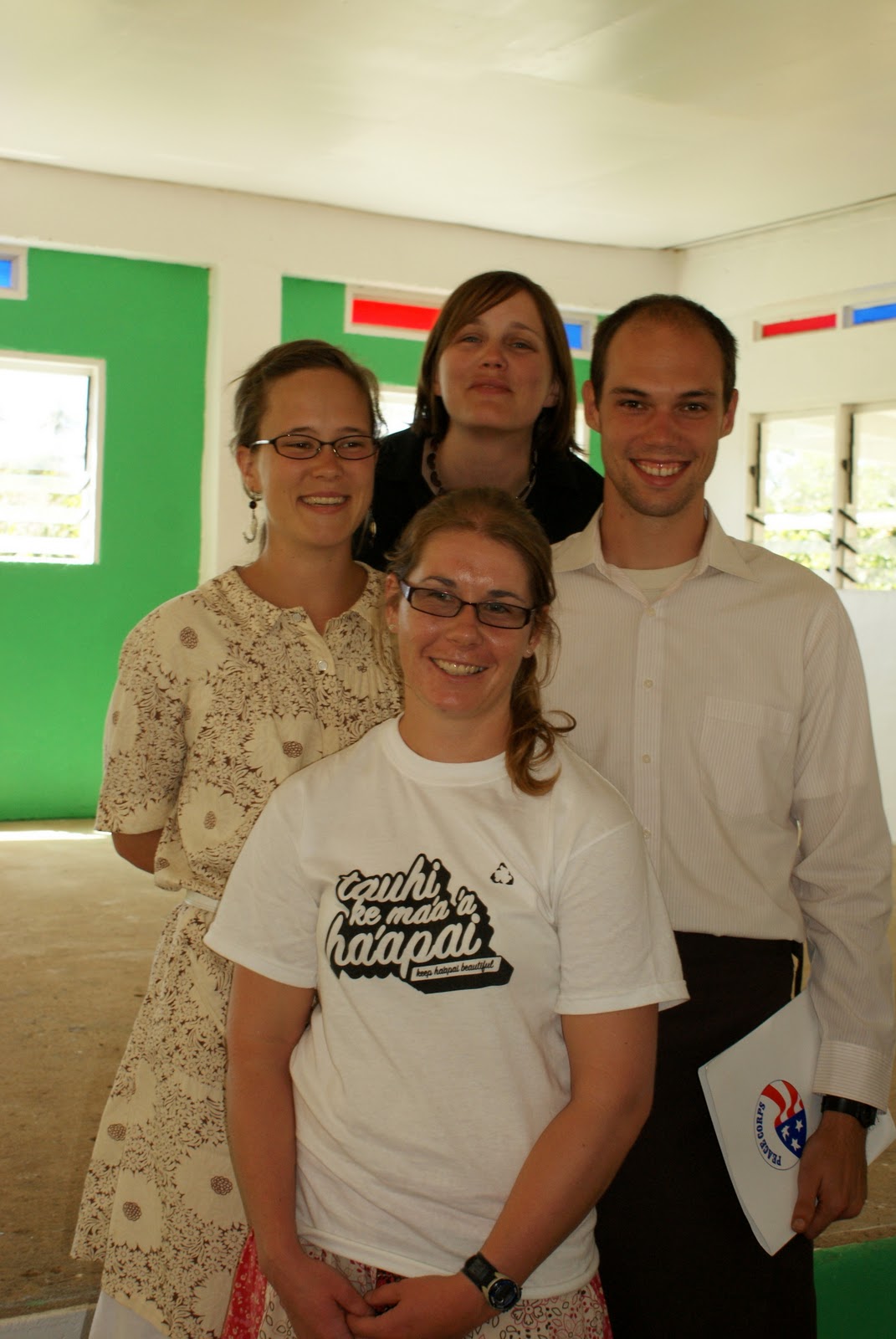
Fanagale'ounga crew after the walk

After the walk we got on a boat and travelled to Ha’ano, an island a little north of us. 
The boat ride was sort of cool at first, but after a while it got pretty old, especially if you were sitting in the sun. When we got there we split into teams and did a scavenger hunt. We had to ask random people questions and take photos. It went pretty well, although there was quite a bit of awkwardness and blank stares when we tried to explain what we were doing and ask people questions! My team wasn’t too competitive, and we came in 5th place (out of 8), but it didn’t really matter, because everyone got the same prize anyway (some school supplies) except the first place people. After that we ate snacks and learned how to open coconuts with a machete (I’m going to need a lot more practice on that one!). It was cool for Pele, because she got to see her house and the school she’ll be working at (she’s taking over from another volunteer who’s leaving).

On the boat to Ha'ano


Me posing at one of our "hunt" items- a weaving house

After we got back, we went home and tried to figure out something to do, since it was Halloween. We ended up just getting together with the group from the next village over and watching “The Office.”

Sunday was pretty much the same as usual- lots of relaxing and eating. There was some kind of performance put on by a Pentecostal group from ‘Eua, so we watched that for awhile, along with the rest of the village, even though we didn’t really understand what they were saying.

Yesterday (Monday) we had a cooking session where we learned how to make Tongan food, although the Tongan-ness of a few of the dishes was questionable (like the salad and the vegetarian stir-fry). After we cooked we had a little feast and it was great! It made me excited to get to my site and cook for myself- no more boiled root crops and corned beef! I also got a letter yesterday from Cheryl (one of the clients, for those who don’t know). It was so cute, it made me cry! 

Anyway, that’s what’s been happening. I’ll try to post some more pictures soon! Hope everyone is doing alright. Feel free to write or call any time!

          -Melissa

Monday, October 19, 2009

First Weekend in Ha'api

I went to church with my host family for the first time yesterday. I wasn’t really sure which denomination they were, but I was hoping they belonged to the Free Church of Tonga because I had heard they have the shortest services. I had also heard from one of the current volunteers that this denomination has the “yell-singing.” After attending yesterday’s service, I think that is an accurate description! There were only about 20 people in the church including the children, but they all sang at the top of their lungs. I’m not sure if it was to make up for the small number of people or if there is some kind of competition among the 6 churches in the village to have the loudest singing. The church itself was down the road in the next village, Fotua.

I was surprised to discover that my host father, Sio’ata, led the service. I had no idea what was being said, but he seemed very serious about it, and it was strange to contrast that with his normally goofy personality. There were little kids fidgeting, playing, and just walking around the building the whole time- at one point this little boy actually went up and started swinging on the railing in front of the altar. Nobody seemed to be phased by any of it- I kept expecting someone to run up and pull him down, but I guess they just ignore it. I was happy to discover that, as promised, the service only lasted about 45 minutes, and then we were on our way.

After church we ate, my host mom made a dish call lu, which is corned beef, onions, and coconut cream wrapped in leaves and baked in an umu. I’m not crazy about corned beef, especially after learning that it contains “75% meat and 25% beef hearts,” but Tongans seem to use it in a lot of dishes, so I tend to sort of eat a little and then say I’m full and that seems to work. It’s funny, because there is all this delicious fresh fish and shellfish here, but instead they use canned meat! I think I’m going to try to mention how much I like the fish and hopefully that will do the trick.

Our Tongan class is going well, I’m learning a lot. It’s funny, because there are lots of works that start with “faka,” which means “like,” and I always sort of feel like I’m cussing, especially when I say the Tongan word for “pitiful”- “Faka’ofa.” It’s nice to be able to sort of understand what people are saying to me, although I certainly still have a long way to go!

We learned at our training on Friday that we have to learn and perform a Tongan dance for “Culture Day” in November, and we also have to teach someone in our host family something American. I think we’re going to get all of the neighborhood kids together for our performance, but we still haven’t decided what to teach them- we were thinking maybe the Macarena or some kind of line dancing (or something else hilarious). Our host families are really excited about teaching us a dance too- me and Pele (Blair) are going to perform one together and there has already been talk of costumes by our host moms, so I’m sure our performance will be interesting to say the least.

Anyway, sorry about the lack of new pictures- the connection at the internet cafĂ© here is incredibly slow and the last internet mission on Saturday was a failure picture-wise. I’ll try again next time but I might have to wait until the end of training when we go back to the capital. We are going to find out what our sites will be next week, so that’s exciting. We have meetings today (Monday) to discuss our preferences for placement. I’m pretty sure I’ll be working in a Secondary school, so I that means I won’t get sent to any of the really remote islands (which I’m glad). I’ll try to let everyone know as soon as I find out! Have a nice week!

-Melissa

Friday, October 16, 2009

My First Post!

Hey everyone! So I’ve decided to try out the blog thing. I figure this is a good way to keep everyone updated on what I’ve been up to in Tonga. Feel free to comment! 

So we arrived in Tonga after a 10 hour flight (which really wasn’t too bad) and a stopover in Samoa, where we left the 15 or so Peace Corps trainees who are serving in Samoa and continued on to Tonga. We crossed the International Dateline and lost an entire day...we pretty much went straight from October 6th to October 8th, so that was a bit confusing at first. We were met at the airport by a big welcoming party of Peace Corps staff and some of the current volunteers, which was really nice albeit a bit of a sensory overload for us, being sleep-deprived and jet-lagged.

From the airport, we were taken to Sela’s guesthouse in Nuku’alofa, the capital of Tonga and located on the main island of Tongatapu. Despite being the largest city in Tonga, it’s still pretty small and there aren’t too many people out and about. We stayed at Sela’s for 4 nights, during which time we did daily training sessions at the Peace Corps office. We soon figured out that the word for white person here is “palangi,” because everywhere we went we would attract a crowd of kids yelling “palangi!” and chanting “hi!, bye!” over and over. Adults have been a little more subtle, but you can still hear the word several times in the conversations people are having near you. 

On that first Sunday we went to church, since Tonga is a very Christian nation and almost everyone goes to church on Sunday (if not more often). It’s actually against the law in Tonga to work on Sundays and all businesses are closed except a few, such as one bakery and a Chinese food restaurant. Our Tongan trainers told us that these are open so the palangi tourists can find something to eat, but I noticed that when I walked by the bakery there was a line of Tongan’s out the door, with no palangis in sight!!

Another interesting thing about Tonga is that people dress very modestly. Us girls have to wear skirts that come at least to our knees, preferably longer, and always have our shoulders covered and a modest neckline. The men have to wear long pants or the “tupenu” or men’s skirt. Most of the guys in our group have bought one, and it’s been pretty funny watching them get used to wearing skirts, especially when it comes to sitting and crossing legs! Anyway, back to the church…we were given three options: the Catholic church, the Anglican church, or the Wesleyan church. I went with the Wesleyan, mostly because I’d never been to one and I hoped it would be less boring than my other church experiences. I have to say it was still pretty boring, especially since the service was all in Tongan, but they did have some beautiful singing. Apparently Tongans are known for their singing, especially in church. In our church, they sang these beautiful harmonies accompanied by a tuba (from what I could hear). Also, we got to see the King of Tonga, because he goes to that church. He sat in his own special section by himself. The Prime Minister of the Cook Islands was also at the church that day, so apparently it’s where all the V.I.P.s go!

After church we had a feast at the country director’s house. The country director, Kelly, has a house near the ocean with a big lawn, where we had our feast. They roasted a pig and made an “umu,” which is an underground oven. In this they cooked Taro leaves filled with a corned beef concoction (I didn’t try it). We also had boiled yams, salad, fruit, and this dish made with raw fish, tomatoes, and peppers that is kind of like ceviche. After the feast they fed us ice cream cones, which were awesome.

On Monday we flew to the island group of Ha’apai, which is north of Tongatapu. We were picked up at the airport by our host families, who we’re going to be staying with for the next couple of months of our training. In the village I’m living in, there are only four of us trainees- Farfum, John, Blair, and I. Most people have been given Tongan names- Farfum is “Feleti,” John is “Sione” and Blair is “Pele”, but apparently Melissa is a Tongan name too so mine didn’t need to be changed- I just have to make sure and pronounce it “Mey-Lee-Sah” so people know what I’m saying.

My host family is really nice. The dad’s name is Sio’ata, and I guess he’s a fisherman, because the first night he said he was going to go spearfishing. The mom’s name is Petelina and she has been cooking food for me and doing my laundry too, which is awesome! She’s always trying to stuff me with food at every turn, and I think her favorite phrase is “kai lahi!” which means “eat more!” They fed me lobster for lunch on Tuesday, which was pretty cool. They have one daughter named Sa’ane who I think is about fourteen. She has also been very nice and helpful, and she braided my hair for me on Tuesday. No one in the family speaks much English, so it has been interesting trying to communicate. I think my most-used phrase is “sorry, I don’t understand” (“fakamolemole, ‘ikai mahino”) and sometimes Sa’ane says it for me before I have a chance.

I’ve started my Tongan language classes though, and I’ve made rapid improvements in the last few days. It’s nice because our class is really small-just the four of us who live in the village, which is called Fangale’ounga. We meet each morning at the house our language trainer, Poli, is staying in. Poli is very nice and friendly and is a great teacher.

My host family has been really good about helping me study with my flash cards too. The first day I stayed there my host mom gave me a “kie kie,” which is like a belt with strips hanging from it that Tongan women wear. It’s made of coconut leaves in a sort of flower pattern and from what I could gather, my host mom made it for me, which is really cool. I’ll try to get a picture of it. I gave the family the gift I had bought for them as well- beef jerky and a calendar with California scenery. I’m not so sure about the calendar, but the beef jerky seemed to go over really well- I think they had finished the pack by the next day.

Anyway, the scenery here is really beautiful. The plants are really green and lush, and the water is a turquoise-blue. The beach is just down a path from my house and it’s really gorgeous, with white sand and shells and coral all over. The island that the airport is on also has the main town- Pa’angai. The runway of the airport actually bisects the town’s main road, so they have this railroad-crossing –like thing that they put down every time a plane is landing or taking off. My village is actually on another island that is very close and is connected to the main island by a causeway, so people can drive straight across it. My village just has one main road, with a bunch of houses, one store, and a couple of churches.

The house I’m staying in is really nice- it’s pretty big and they have a garden in the back where they grow bananas, taro, and manioc. They also have a mango tree, but I think the season for those might be over, sadly. Most people have a tank or two in their yards where they collect rainwater, which is used for drinking, washing, and bathing. I’m lucky because my host family has a flush toilet and a shower, although the water is cold. It does feel good on a warm day though.

On Tuesday we did water safety training at the harbor in Pa’angi. After hearing about all of the dangerous creatures that live in the ocean, we had to jump in the harbor and do some swimming. It was pretty funny to have all 23 of us and the staff in the water together. We attracted a crowd of Tongan kid spectators, who I’m sure were very entertained by all the crazy palangis flopping around in their life vests.

On Thursday, all of us participated in a beach clean-up put together by a group of New Zealanders. Apparently, there’s no trash collection or disposal system on Ha’api, so most people either burn their trash or dump it in the ocean, consequently, there’s quite a bit of it along the roads and beaches. We walked the beach between our village and the causeway and picked up trash (or “rubbish,” as the New Zealanders would say). I actually picked up very little trash, as I was distracted by the tide pools and all the things living in them-I saw a few sea cucumbers, some starfish, and a sea slug thing squirting ink. I got a nice sunburn out of it too! So, that’s pretty much what’s been going on lately…I’ll try and give another update soon. I miss you all, everyone feel free to give me a call!

-Melissa